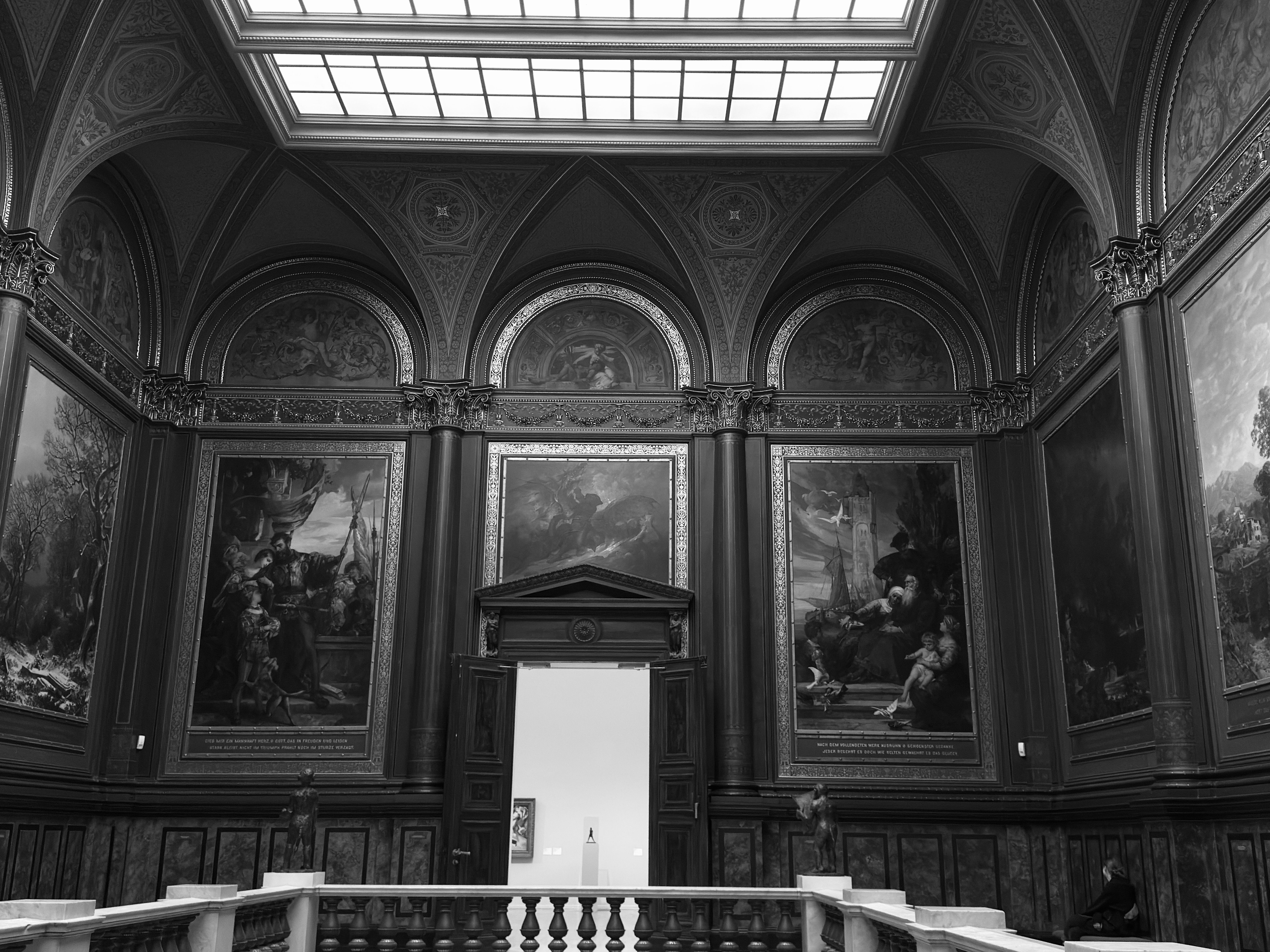
»Our idols today are economic conquest, unending 'growth' built on turning all life into 'resources' for human consumption.«
Paul Kingsnorth · 2025»Beschleunigung und Steigerung werden zur Normalität. Solange wir aus dieser Logik nicht heraustreten, sind alle Versuche, die durch Steigerungen entstandenen Probleme zu lösen, nur kosmetisch.«
Maja Göpel · 2022»Population will inevitably and completely outstrip whatever small increases in food supplies we make. The death rate will increase until at least 100-200 million people per year will be starving to death during the next ten years.«
Paul Ehrlich · 1970Germany, like Kingsnorth, Göpel, and Ehrlich, fears the future. We are afraid, see only risks, want to prevent as much harm as we can. Progress seems philosophically discredited and not even utopian anymore. In fact, the opposite is true: today's posture of prevention is morally indefensible; progress is possible, valuable, and worth striving for.
Why was progress thrown out? Behind the rejection lies a cluster of cultural shifts rather than one decisive argument. Hegelian philosophy of history and Whig historiography come to mind first, the belief that everything must inevitably get better. Obviously no such inevitability exists. But this critique does not touch a concept of progress that builds on contingent advances: progress has to be worked for and fought for.
Progress also looks discredited because technical advances bring their own problems; what looks like technical progress can also be regress.
This attitude took hold after two world wars and the atomic bomb. What was true of the industrial revolution holds even more for the digital and AI revolutions. Anyone opening a newspaper these days can scroll through pages of problems and worries.
Technology, growth, and markets also caused suffering, and that has to be acknowledged honestly. But to reject the system we owe most of our improvements to would be the wrong response to history. The greatest harms have always come from the state: state-sanctioned violence, ordered terror. And yet the anger of the anti-progress movements lands less on the state than on science, markets, and liberalism.
Since the seventies, what won out was not just an awareness of problems — the Enlightenment had already had that — but the idea that human beings themselves, through their use of natural resources, were modernity’s original sin. History shows otherwise: from the smog of the early industrial cities, to the diseases of the great cities, to the deadly accidents of the first airplanes, we can solve these new problems. Often with new technology, sometimes with reasonable regulation, always with human creativity and cooperation.
If problems always stop us from developing and testing technologies, we lose untold benefits. Among them, the kind that improve, enrich, lengthen, and sometimes save people’s lives.
Put more sharply: anyone who only sees the risks but not the opportunities — who only prevents but does not explore and enable — also prevents healing, rescue, and prosperity for those who urgently need them. They wrong all those billions of people whose lives could be so much better — they wrong all of us. Problems and suffering come not only from technological development and growth, but at least as much from their prevention.
The big objections to progress fall away once we separate technological, moral, and institutional developments conceptually from progress itself. Not every development is then progress; well understood, progress means: a development that gives people more space and more possibilities to live by their values.
Such a history is easy to write. Anyone reading this knows the list of achievements, as set down by Johan Norberg, Steven Pinker, and Hans Rosling. Deaths from hunger have fallen rapidly, rivers and seas are cleaner, growth and CO2 emissions have decoupled. Less violence, more rights for women and minorities. And countless other innovations that make our lives better and healthier each year, think of gene therapy for deafness or vaccines against cancer.
Some future developments are already visible today. They could be progress on every level: technical, institutional, moral. Take AI, where current models, from Claude Opus 4.7 to GPT 5.5, are rapidly redistributing power in our societies. How often have liberals warned that the individual, the small business owner, the startup stand no chance against large firms in the thicket of regulation. How often the state and big firms get away with smaller and larger acts of harassment, because going to court does not pay for any one person.
All these problems are in the past, or could be in very short order. Already today, more and more people in the US represent themselves in court.

That alone shifts the social balance of power fundamentally. Institutionally, power moves toward freedom; morally, the autonomy of those previously at the mercy of higher powers grows. Technically, the leap is enormous: all the specialist knowledge once reserved for elites — the expensive lawyers and specialists — is being put within everyone’s reach by the latest models in no time.
A lot has been achieved already; much more is in development. But this is not the end of the line; we have not reached utopia. We stand at the very beginning of an unimaginable development. At least, if we play this smart, revive a culture of innovation and progress, and place trust in the human capacity to solve a great many problems in free cooperation.
What holds us back: with all the caution, the doubts, and the criticism (some of it unjustified), we have lost sight of progress. Germany was not alone in this. But in the UK and the US a movement has formed that wants to fix it: the progress movement. In its various forms, the possibilities of progress are imagined, developed, and politically enabled. Some work on a culture and philosophy of progress; others develop historically informed approaches to what progress might concretely look like. At the same time, conservatives, liberals, and social democrats spell out in detail what a progress-friendly politics means. It even wins elections.
The Anglophone progress movement shows that new possibilities don’t only lie in the abstract or the distant future. Many problems of our present are rooted in self-inflicted scarcity: too few homes exactly where people want to live, too little clean energy, too few medicines for fatal diseases, too few ways to travel the globe. In many cases we have to clear away the hurdles our societies built themselves.
An important part of the progress movement, therefore, is the Abundance Movement and the YIMBYs, the Yes-In-My-Backyard activists who want to bring dynamism back to our cities rather than guard the status quo. Always with an eye on what progress is: what makes people’s lives better. That, too, is the strength of the progress movement. It can unite different social groups again in a common fight for human possibility, at the frontier of knowledge, of abundance, of progress.
The greatest opportunity, though, lies with liberals. The promise of freedom has lost much of its glow over the past decades. But whenever liberals remembered their enthusiasm for progress, they could also restore some shine to their love of freedom.
The liberal tradition has its parts to add to the progress movement. A view of the human being, for one: enlightened, curious, forward-looking, aimed at cooperation and the good. Institutions too: markets, science, free discourse. The combination of general rules people give themselves and open spaces for thinking and experimenting. Or the formula of spontaneous order and price signals in the distribution of scarce resources. And the liberal aim: to make the lives of all people freer and better. Because progress does not mean technocracy, centralised statehood, mechanization, and uniformity. Moral, institutional, and technical progress flourish exactly where people live together freely and in the most varied ways.
How then do we bring our frozen society back to life, in a liberal, enlightened spirit, as a place of new beginnings, of freedom, of progress? How do we give space to those who want to experiment, research, try, and renew, those who right now are either despairing or planning to leave?
This only works through cultural change; the fight has to be fought first in the space of culture, of ideas. The good and useful parts of our intellectual heritage — markets, science, the insights of the Enlightenment — we must rescue from the condemnation of the past decades. They have to find their way back into museums and films, into schools and universities.
We are not there yet; for now, everyone apologizes: too much upheaval, change, adaptation. Everything too fast. Nonsense. It is not too fast, it is still far too slow. Ahead of us lie incredible advances, billions of new possibilities for everyone: health, prosperity, knowledge. But only if we dare.