Translated from German with the help of AI. The original is the authoritative version.
It is by now a sad fact that no text on contemporary liberalism can do without the obligatory, and somehow pitiful, diagnosis of crisis. But don't worry, I'll keep it short. We all know where the problems lie and have run through them in every conceivable format a thousand times: the rise of populism as a decidedly illiberal ideological antagonist, the hollowing-out of liberal democracy from the inside, the return of geopolitics and zero-sum games in international relations, and the slide of our own ordering vision from the dynamic open society into the bureaucratic-static institutional sclerosis that today paralyses the Western world.
All this has pushed liberalism as a political project to the edge of discourse.
Normally one would expect a thoroughly intellectualised tradition like liberalism to have a wealth of clever and considered answers to this crisis. After all, we all too gladly present ourselves as heirs to the Enlightenment avant-garde. All the more astonishing, then, that in liberal circles, besides the obligatory wrestling with the zeitgeist and a lot of shoulder-shrugging, one meets above all empty content. Our credos have degenerated into mere stay-the-course slogans. Once pioneers of their time, liberals have become the new conservatives with their own well-known and stale patterns. It almost seems as if liberalism, paradoxically, has fallen out of its own time. The cynical conclusion is close at hand: perhaps „The End of History” (to throw another coin into the cliché jar for the obligatory Fukuyama reference) is not the triumph of liberal democracy but, in Trotsky’s words, the „dustbin of history” for the idea(s) of freedom.
And precisely that should give liberals pause. Maybe it really is our ideas that are no longer fitting for the time. Because let’s face it: our parties lose elections one after the other despite the most extensive platform documents, intellectual debates pass us by, books about liberalism prefer to look back rather than forward, our panels reach no audience anymore, and we have no more thought leaders anyway. Even our critics, like Amlinger and Nachtwey, no longer occupy themselves with the evil liberal individualism; they have long moved on to the new kids on the block, the self-styled post-liberals. And this terminology alone tells you everything: post-liberalism. Liberalism was simply, en passant… overcome; the liberal soap bubble appears to have burst.
Now we can either hang our heads or pull ourselves together again. It would not be the first time that liberals find themselves in an existential crisis. Of course today’s conditions cannot be compared one to one with earlier ones. Never before could liberalism rest so much on the achievements of its own history as it does today. Yet a look back is worthwhile. Not out of nostalgia (that does not suit us anyway), but to call up an old and at the same time new spirit: the spirit of Mont Pèlerin.
When in April 1947 the last remaining liberals of the postwar period gathered at the foot of the Swiss Alps to found the Mont Pèlerin Society, they faced a similar challenge. There too the issue was nothing less than the intellectual revival and ideational reconstruction of the liberal order. The conditions, however, were dramatically harsher: fascism had left Europe in ruins, and in many countries food was still rationed. Anyone drawing the historical parallel may think: things are luckily (still) not that bad today. But that holds no comfort. The actual Mont Pèlerin moment began years earlier and only bore fruit once the worst was already over. And precisely this should give us pause today: we should not act only when it is already too late.
The intellectual-historical trace of the spirit of Mont Pèlerin leads back to Paris in 1938, a whole decade earlier. There, with the Colloque Walter Lippmann, the first serious attempt was made to lead liberalism out of its own disorientation. Inspired by Lippmann’s work The Good Society, thinkers like Friedrich August von Hayek, Ludwig von Mises, Michael Polanyi, Alexander Rüstow, Wilhelm Röpke, and Raymond Aron gathered to give the ideas of freedom a new theoretical frame.
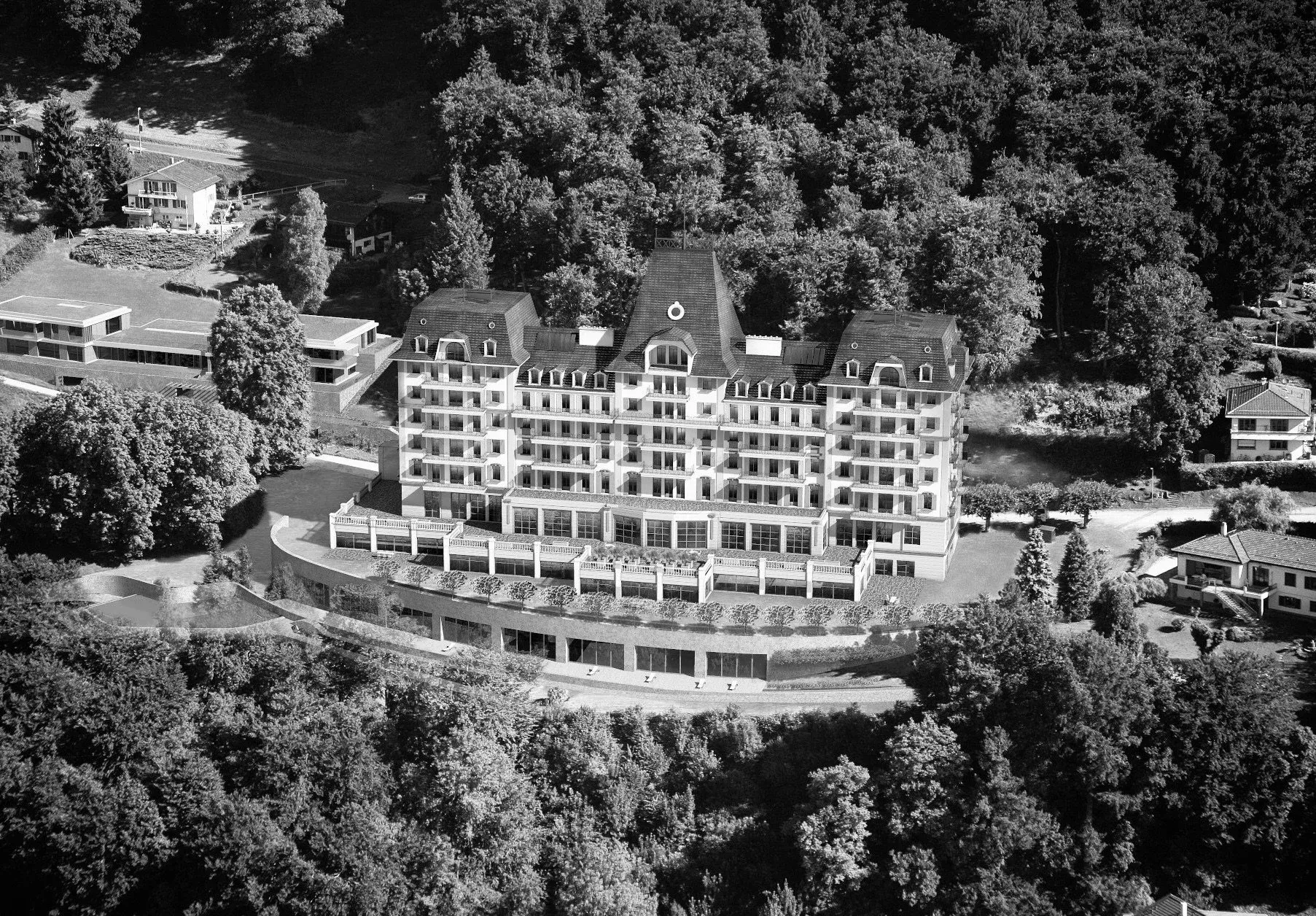
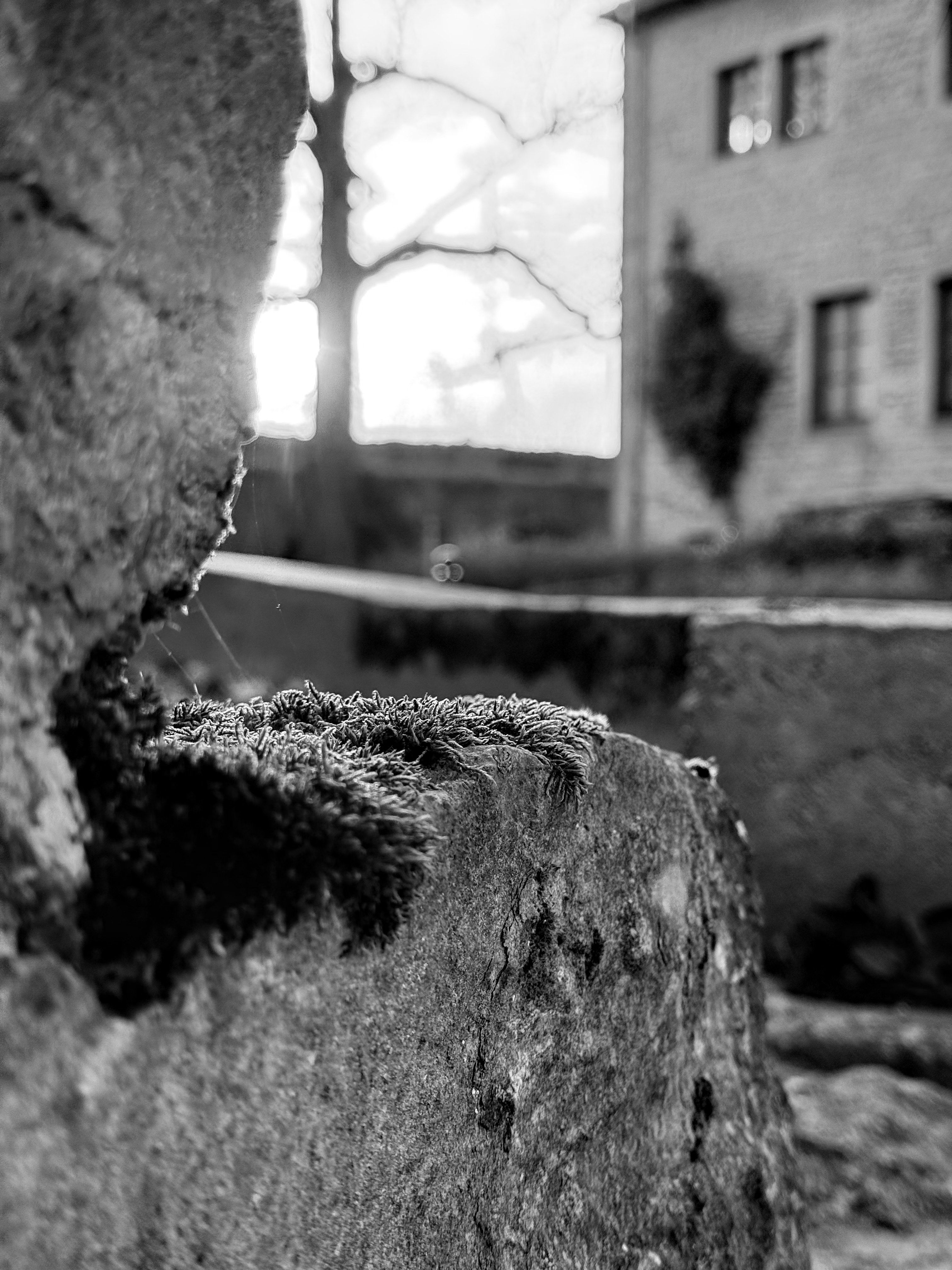
Pèlerin Palace, by Vadimdk, CC BY-SA 4.0, edited bw
What sounds at first like a harmoniously constructive project was in reality a fierce struggle for intellectual primacy and interpretive authority. What else should one expect from a room full of individualists? While the German ordoliberals argued for a fundamental renewal of the liberal idea and a clear turn away from past laissez-faire, Hayek and Mises did not want to turn their backs on classical liberalism entirely. These tensions led to sometimes heated debates and occasionally remarkably sarcastic remarks. Perhaps this explains why the Paris colloquium never produced a lasting structure.
One could agree at the meeting on certain, if rather rough, guidelines of a neo-liberalism and afterwards even create, with the „Centre International pour la Rénovation du Libéralisme”, a possible structure to continue the dialogue. But both the outbreak of the war and the lack of commitment of the participants choked these initiatives. Lippmann himself attended no further meeting, not even the later Mont Pèlerin Society. What remained were above all the animosities. The colloquium thus became more the prologue of the liberal revival project than its actual departure.
It was precisely such a departure that Friedrich August von Hayek worked on. He had, as had Röpke, not yet given up the idea of a permanent philosophical working group. Disturbed by developments in postwar Europe, Hayek proposed in a 1944 Cambridge lecture the founding of a liberal society of thought leaders. Ultimately 39 academics, writers, think-tankers, and intellectuals followed his call to Lake Geneva. From Hayek’s impulse a lasting institution arose. And this structure gave liberals in the end the tools and the ideational self-assurance with which, over decades, they had far more impact than anyone could have imagined at the time.
Why do I tell all this? Because Germany too needs a Mont Pèlerin moment today again. And although at this point I would dearly love to go into more details of the first meeting of the Mont Pèlerin Society, I refer here to the excellent works by Bruce Caldwell and Angus Burgin. I want to focus instead on the lessons we can draw from this episode of liberal intellectual history.
First: it is high time to bring the last remaining and probably similarly desperate liberals in Germany back into one room. What took Rougier and Hayek a whole decade we have to manage in a few months. The clock is ticking. But this requires some uncomfortable questions. For example: whom would one even invite to such a meeting? Precisely this difficulty Hayek faced as well, receiving regular biting letters from Mises on his suggestions. These conflicts will be ours too. Already an initial list of names I once sketched for myself (and which on request I happily share) made clear that this will not go off without friction and wounded egos. But we have to go through this. We must not fear dissent. The more decisive question, in any case, is whether we even have thinkers of the calibre of that time who could carry such a project. But here too one should not fall into romanticised reverence: Hayek himself was, in spring 1947, only 47 years old and still far from the Nobel Prize. One should not confuse the glow of history with the reality of its beginning.
Second: without long-term structure and reliable funders, such a project cannot take off. Behind the glittering façade of intellectual discourse stands the sober reality of logistics: who organises, and (far more important) who pays? If there is anything we can learn from the great architects and bridge builders of postwar liberalism, it is that intellectuals must not be too good to take organisational responsibility themselves. Hayek personally sent countless letters, sought support, and finally found, in the Swiss banker Albert Hunold and the William Volker Fund, the necessary resources to cover the venue, accommodation, and travel costs of the participants. Today too we need such thinkers and doers who take on the role of making clear to liberal milieus in Germany that intellectual renewal is necessary and, above all, worth funding.
Third: a discourse about the future of freedom has to be conducted today with the same unsparing honesty as back then. The capacity for internal reform must never be understood as betrayal of one’s own tradition. Liberalism must understand itself again as a living, open project that does not, by reflex, look for its crises in external enemies and circumstances. The actual weakness lies in its self-imposed inertia in adapting to new social realities. If freedom is to endure, its concept also has to be spiritually renewed. That requires that philosophical foundational questions are no longer treated as an intellectual pastime. They are the driving forces of every political renewal, and they have to be given that place again. This kind of ontological self-assurance is at present more important than day-to-day political usefulness or attention-grabbing effects. A contemporary liberalism can no longer rest on the quotable lines of its patron saints. It needs its own new vocabulary, its own new thinkers, its own new language, and its own new aesthetic.
Fourth: for all these debates and discourses, infrastructure is needed. Places and retreats are needed where productive argument is possible, where experiments can be made, and where not only new ideas but also new thinkers can mature. Exactly such places are lacking in Germany today. With the closing of the Theodor-Heuss-Akademie, liberalism is now also robbed of its last place of retreat. Some scoffers may say that in recent years the Zauberberg had only fulfilled this role symbolically. But that misjudges its importance for German (and international) liberalism. Its loss leaves, precisely now where one would need it most urgently, a gaping gap. And if this gap is not filled, liberalism loses the spaces in which future generations could intellectually mature and hands them over to an academic-scientific operation that is ever more disillusioned.
Fifth: liberalism needs a utopia again. Especially in Germany, contemporary liberalism has narrowed into a strange form of technocratic pragmatism. As if that were a sign of maturity. In truth it is a symptom of its exhausted imagination. If liberalism is to survive, it has to offer a narrative of the future again, its own. For that it has to learn again to dream and develop moral imagination in order to give the concept of freedom its normative force again. But inspiration alone is not enough. Creative discipline is also needed: places, formats, and routines that make the new even possible. Less panel, more workshop. All of that has been kept small and scorned in recent years. But only when the liberal idea takes shape again in people’s minds can it also be articulated by its defenders with conviction.
Anyone who takes the lessons of Paris and Mont Pèlerin seriously knows what is at stake: a spirit of intellectual, structural, and spiritual renewal. Not more events. This event- and salon-liberalism has had its day. Too many evenings on the „future of liberalism” with too little effect. Germany needs, precisely now, a visionary, forward-thinking, compact, recurring, and result-oriented forum that finally understands liberalism as a work programme again, not as the tending of tradition. For all that, no ceremonial speeches are needed. What is needed are new intellectuals with new courage.
That is the spirit of Mont Pèlerin. And this is exactly what we have to summon again today.